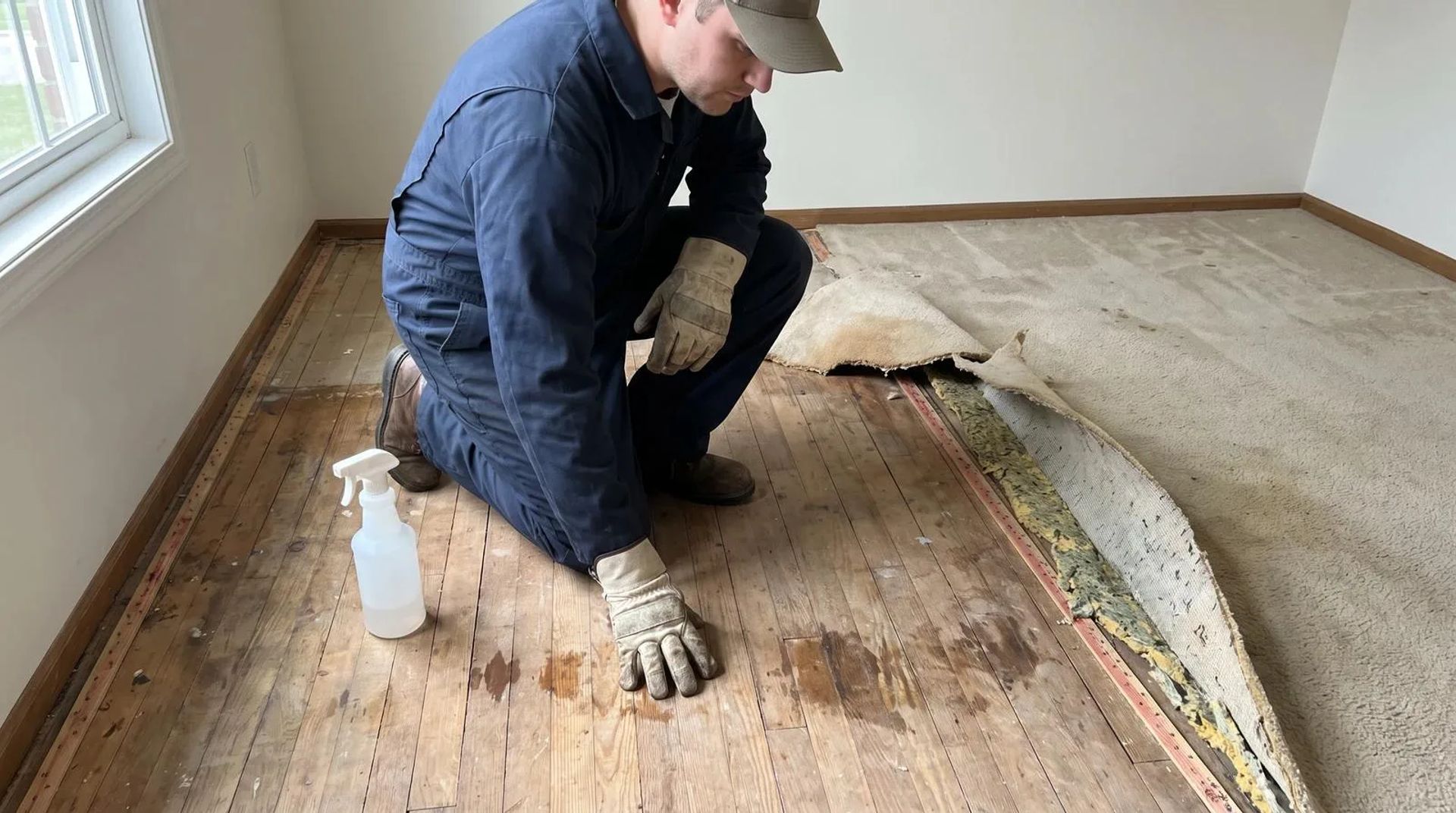
A guy in Nampa met us at his front door holding a gallon of bleach and a mop. He'd been at it for two days. The smell hadn't budged, the stain hadn't budged, and he wanted to know what he was doing wrong.
Nothing, really. What he had on his hands wasn't a cleaning job. It was biohazard cleaning, and those are two different animals.
Bleach is the first thing almost everybody reaches for. It's cheap, it's already under the sink, and it smells like the job got done. That last part is the problem.
What bleach actually does, and what it can't
Bleach is a disinfectant. On a hard, non-porous surface that's already clean, it kills a lot of what you'd want killed. Think sealed tile, a stainless sink, a solid-surface counter.
That's a real job and bleach does it well. It just needs time.
Most household bleach needs to sit wet on the surface for several minutes to do anything meaningful. Wiping it on and wiping it back off thirty seconds later is closer to rearranging the mess than killing it.
The bigger issue is that organic material eats bleach alive. Blood, urine, feces, rotted food in a fridge that lost power in August. Bleach hits that and burns itself out on the gunk long before it gets anywhere near what's underneath.
Pour it on a soiled carpet and you've mostly bought yourself some expensive perfume.
And bleach doesn't remove anything. It's a disinfectant, not a cleaner. The material is still sitting right where it was, which is the whole ballgame.
Why biohazard cleaning is really about what's underneath
Most homes around here have carpet over pad over a wood subfloor. The older bungalows in Boise's North End and a lot of the mid-century places on the Bench still have original hardwood under it.
Liquid doesn't respect any of those layers. It finds seams, tack strips, the gap where drywall meets the floor, and it keeps going.
So the surface can look handled while four inches down nothing has changed.
That's why the real work is usually removal, not scrubbing. On a saturated area we pull the carpet and pad, take off the baseboard, and cut drywall above the highest line the moisture reached. Then the subfloor gets treated and sealed, and sometimes the plywood comes out too.
Anything porous either gets extracted or it leaves the house. There's not much middle ground.
Here's a test anybody can run at home. If it still smells once everything is dry, something porous is still holding it.
Your nose is usually right about that. Ozone machines and air scrubbers clean the air in a room, which helps, but neither reaches into a soaked joist.
Heads up: If an odor you thought you beat comes roaring back on a hot afternoon, that's not the cleaning failing. Heat pulls it back out of the material. In a closed-up Treasure Valley house in July, you'll smell in one hour what you didn't smell all spring. That means the source is still in there.
The biohazard cleaning mistakes we see most in Treasure Valley homes
Mixing products is the one that scares us. Urine already contains ammonia, and bleach plus ammonia makes chloramine gas. People end up at St. Luke's over a bathroom floor.
If you're going to use bleach, use only bleach, and open every window you've got.
Then there's the shop vac. A standard one without HEPA filtration takes dried waste and blows the fine particles back into the room in a cloud you can't see. You've turned a floor problem into an air problem.
Masks trip people up too. That paper mask hanging in the garage is for sawdust. For dried rodent waste or anything that aerosolizes, you want a P100 respirator that seals to your face, gloves past your wrist, and something disposable over your clothes.
Disposal is the last one. Saturated carpet, sharps, and certain contaminated materials don't go in the curbside bin. Loads get staged and handled so they can go to the Ada County landfill properly, and a few categories route somewhere else entirely.
Worth knowing before you fill the truck bed.
When you can handle it yourself, and when to call
Small, fresh, contained, and on a hard surface? Handle it. A clean-water toilet overflow on tile that you catch in ten minutes is gloves, towels, and a mop.
Yes, we'd love your business, but we're not going to pretend that one needs us.
Call somebody when there's blood or bodily fluids from anyone outside your household. Same after an unattended death. That's its own kind of hard day, and not something anyone should be scrubbing alone.
Sewage that's gotten past the bathroom onto carpet or down into a crawlspace is another one. So is an active rodent problem with dried droppings, or waste that's been sitting long enough to soak in.
Winter brings us most of the crawlspace calls. A freeze cracks a line in a Meridian house out near Ten Mile, and nobody notices until the smell starts.
What does it run? A single contaminated room usually lands somewhere between a few hundred dollars and a couple thousand, depending on how much material comes out and whether flooring gets cut.
Multiple rooms or a whole-home situation climbs from there. One room is generally a day of work. A bigger job runs three to five days once you count demo and drying time.
The bottom line
Bleach is a finishing step, not a plan. Take the material out first, disinfect what's left, then seal it. Anything porous and saturated is going to the landfill instead of getting saved.
If you're standing in it right now and you're not sure which side of that line you're on, call us at (208) 330-3615. We'll ask a few questions and tell you straight whether it's a gloves-and-a-mop afternoon or something you'd rather hand off. Either answer is fine with us.
