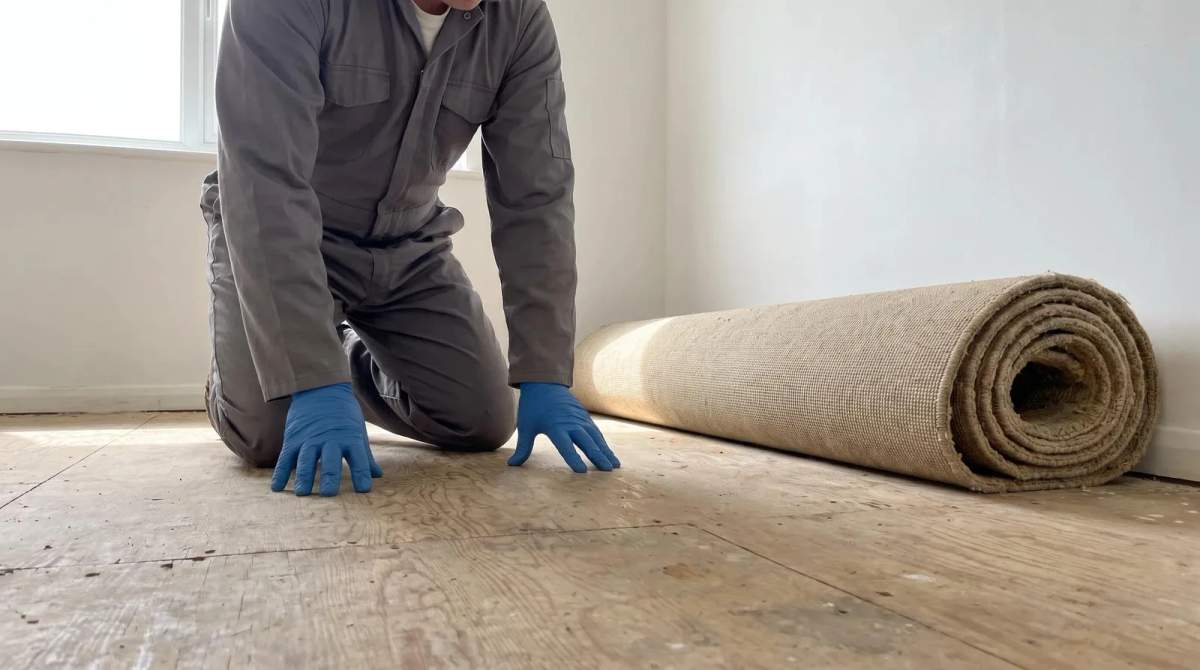
Most people don't call it biohazard cleaning at first. They call it a cat smell. A lot of the time they've already pulled the carpet and the pad themselves, hauled it to the curb, and run a rented ozone machine.
The smell is still there. Sometimes it's worse, because now there's nothing between them and the plywood.
That's usually how these calls start. Not "I need help with a biohazard," but "I tried, and it came back."
Pet urine is one of the most common reasons we end up doing biohazard cleaning in Boise homes, and it's the one people underestimate. A dog accident on carpet is a Saturday afternoon. Years of cat urine in the same three corners of a bedroom is closer to a small remodel.
What turns pet waste into a biohazard cleaning job
There's no single line where it flips over. A few things push it there fast, though.
Time and volume come first. One animal, one accident, cleaned up that day, is housekeeping. Several cats over a few years in a house where the litter boxes got away from someone is a different situation, and it's more common than people think.
Sometimes it's part of a bigger picture. Someone got overwhelmed, the house got ahead of them, and the animals were the one thing still bringing comfort. Nobody gets a lecture from us.
Urine doesn't sit still, either. It wicks through carpet into the pad, then into the seams and nail holes of the subfloor, along the tack strip, and an inch or two up the drywall behind the baseboard. By the time you smell it from the hallway, it's already in the wood.
Animal waste is the other half of it. Dried feces can carry roundworm eggs and other pathogens that stay viable a long time, which is why we show up in respirators and suits, not dust masks and dish gloves. That's not drama. It's just what the material is.
Then there's the air. Ammonia builds up in a closed room, and a house shut tight through a Treasure Valley summer concentrates it fast. In a closed-up house in August, it can be strong enough to make your eyes sting within moments of walking in.
Tip: Before you pull anything up, buy a cheap UV flashlight and kill the lights at night. Old urine glows. It almost always runs further than the stain you can see, so mark the real edges with painter's tape before you start cutting.
Why the smell keeps coming back after you clean
This is the part that makes people feel like they're losing it. You clean, it's fine for a week, then it's back.
Urine dries into uric acid crystals, and those don't rinse away with soap and water. They sit there dormant until moisture wakes them up. A room can smell fine in dry July heat and then hit you again the first week the weather turns, or in January with the furnace running and the windows shut.
Ozone doesn't fix it. It knocks the odor down for a while by working on what's in the air, but it can't reach the middle of a saturated sheet of plywood. Masking products are the same story with a nicer scent on top.
Enzyme cleaners actually do work. The catch is they have to physically touch the contamination, and they have to stay wet long enough to finish. On a sealed hardwood floor, usually fine. On particle board that soaked up a gallon over two years, no.
What you can handle yourself, and where it stops
Can you do some of this on your own? Yes, and we'd rather tell you that than sell you something you don't need.
Carpet and pad come out with a utility knife and a couple of hours. Bag it, tape it, and it's a straightforward run to the Ada County landfill. If the damage is one small area on a sealed floor, an enzyme product and some patience will usually get you there.
Where it stops is saturated wood. If the subfloor is stained through and still smells after it's been cleaned and dried all the way out, more cleaning isn't going to win. That section gets cut out and replaced, or it gets sealed with a shellac-based primer once it's dry. In a bigger house it's often both, in different rooms.
Drywall that wicked up at the base is another one. So are HVAC returns that pulled odor through the rest of the house. And if you're finding waste and not just staining, that's where protective gear stops being optional.
What biohazard cleaning for pet waste costs around the Treasure Valley
Nobody can quote you a real number over the phone without seeing it. Anyone who does is guessing.
Ranges still help. One bedroom, carpet and pad out, subfloor treated and sealed, usually lands somewhere between a few hundred and around a thousand dollars, and it's typically a one-day job. A whole house with several affected rooms, some subfloor replacement, and heavy disposal can climb into the several-thousand range and run three to five days.
Square footage moves the price. So does the number of layers that have to come out and how much weight we're hauling off. Access matters more than people expect. A ground-floor ranch in Meridian off the Ten Mile corridor is easier to work than a second story in Boise's North End with a narrow staircase.
The bottom line
If it still smells after the carpet's gone, the problem is in the wood. Cleaning the surface again won't change that. Find out how far it spread before you spend money on the wrong step.
Want a second set of eyes on it? Call us at (208) 330-3615. We'll tell you straight if it's something you can knock out yourself.
