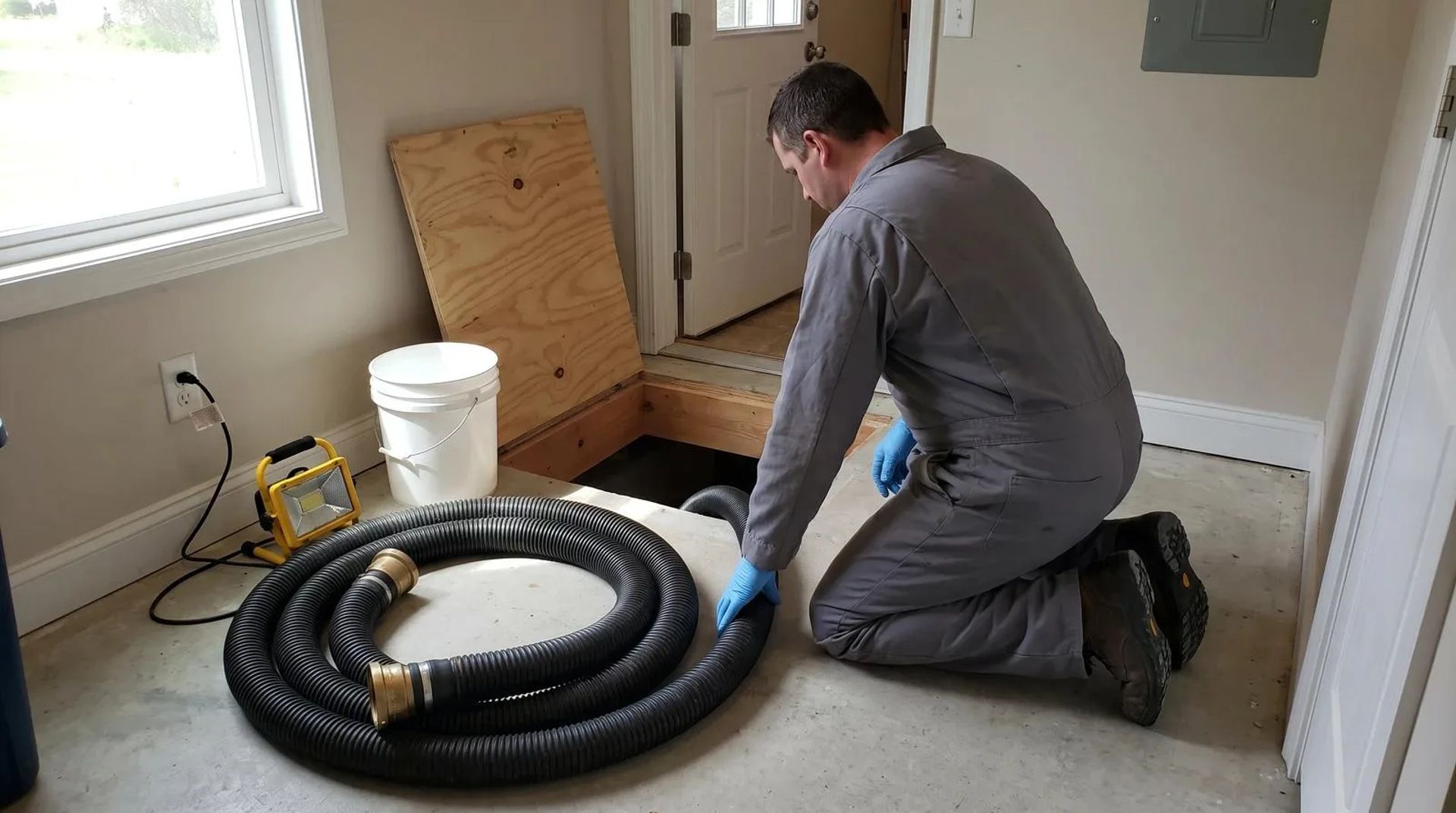
The call almost always starts the same way. Somebody in the North End heads down to the basement, smells something they can't quite place, and finds an inch of gray water sitting around the floor drain. By the time they call us, the question is whether this is a mop-and-bucket afternoon or an actual biohazard cleaning job.
If the water came back up out of a drain, a toilet, or a shower pan, it's biohazard cleaning. Not because we want it to sound worse than it is. Water that's been sitting in a sewer line is a different animal than water from a burst supply pipe.
Why sewage counts as biohazard cleaning
Restoration work sorts water into three buckets. There's clean water from a supply line, gray water from a washer or dishwasher, and black water, which is anything that's touched sewage.
Black water carries bacteria and viruses that don't care how clean the house was ten minutes earlier. E. coli, hepatitis A, giardia.
You don't have to memorize any of that. You just need to know that wiping it up and spraying something on top does nothing about what soaked in underneath.
Sewage doesn't stay on the surface. It wicks into carpet pad, up the bottom edge of drywall, into the seams of laminate, into the underside of particleboard cabinets.
So a floor can look dry by morning and still be growing something two days later.
Here's the part that catches people off guard: the smell comes back. Somebody cleans up a backup in July, it seems fine for a couple of weeks, then a hot stretch hits and the whole basement smells again.
Boise summers are dry. Basements and crawl spaces hold moisture a lot longer than you'd guess.
What has to come out, and what can stay
The rule is simpler than most people expect. Nonporous stuff can be cleaned and saved. Porous stuff that took on sewage comes out.
Sealed concrete, tile, metal, glass, and solid finished wood usually stay put. We clean them, disinfect them, and they're fine.
Carpet and pad go. Laminate and engineered flooring almost always go too, since the core is basically compressed paper.
Drywall gets cut above the water line, usually a foot or so up, and the wet insulation behind it comes with it.
Cardboard boxes on a basement floor are a total loss. That's usually the hardest part of the day, because that's where the photo albums and the kids' school things live.
Then the space has to dry before anything gets disinfected or rebuilt. Sealing up a wet cavity is how you end up paying for the job twice.
Heads up: Take photos before anything moves. Wide shots of each room, close shots of the water line on the wall, and one of the drain or fixture that backed up. Whether or not you file a claim, those five minutes beat anything you'll reconstruct later from memory.
The crawl space nobody wants to think about
Plenty of homes in Nampa, Caldwell, and out along Meridian's Ten Mile corridor sit on crawl spaces instead of basements. When a lateral line lets go under one of those, the sewage doesn't pool anywhere you can see it. It soaks the vapor barrier and the dirt underneath.
Crawl space work is slower, and it costs more.
The vapor barrier comes out in pieces. Wet batt insulation drops out of the joists and gets bagged, and sometimes we're pulling a few inches of contaminated soil before a new barrier goes down.
All of it comes out through a hatch that's usually about two feet square.
Older houses have a second problem. In the North End and parts of the Bench, plenty of homes still have clay or cast iron laterals with fifty years of tree roots in them.
Those don't back up once. If nobody scopes the line after the cleanup, we'll be back.
How long biohazard cleaning takes and what it costs
A single bathroom or a small finished basement room is usually one day for extraction and demo, then two to four days with drying equipment running before anything else happens.
A full basement with finished walls, or a crawl space under most of the house, runs three to five days of crew time on top of the drying. Dump runs to the Ada County landfill are built into that, since contaminated material can't go in your curbside can.
Cost comes down to square footage and how much has to be removed. A contained bathroom backup over tile usually lands in the low four figures.
A finished basement or a full crawl space with insulation and soil removal climbs well past that, sometimes into five figures. Anyone who quotes you a firm number over the phone without looking at it is guessing.
Winter changes the math too. When it's in the twenties, drying takes longer and we're heating the space just to make the equipment work, so between Thanksgiving and March plan on a few extra days.
One more thing worth checking. A lot of homeowner policies treat sewer backup as a separate rider instead of standard coverage, so read your declarations page before you assume.
Can you handle a small one yourself? Sometimes, honestly. If it's a few square feet on sealed tile, you caught it right away, and you've got gloves, a respirator and a way to bag it, that's a reasonable Saturday.
Anything that soaked into flooring, walls, or a crawl space is worth a crew.
The bottom line
If it came out of a drain, treat it as biohazard cleaning. Pull the porous material, get the space genuinely dry, then disinfect.
Doing those three in the wrong order is the most common mistake we see, and it's an expensive one to undo.
If you're standing in one right now in Boise, Meridian, or anywhere in the Treasure Valley and you're not sure how bad it really is, give us a call at (208) 330-3615.
We'll tell you straight whether it's something you can handle or something you want a crew for. No pressure either way.
