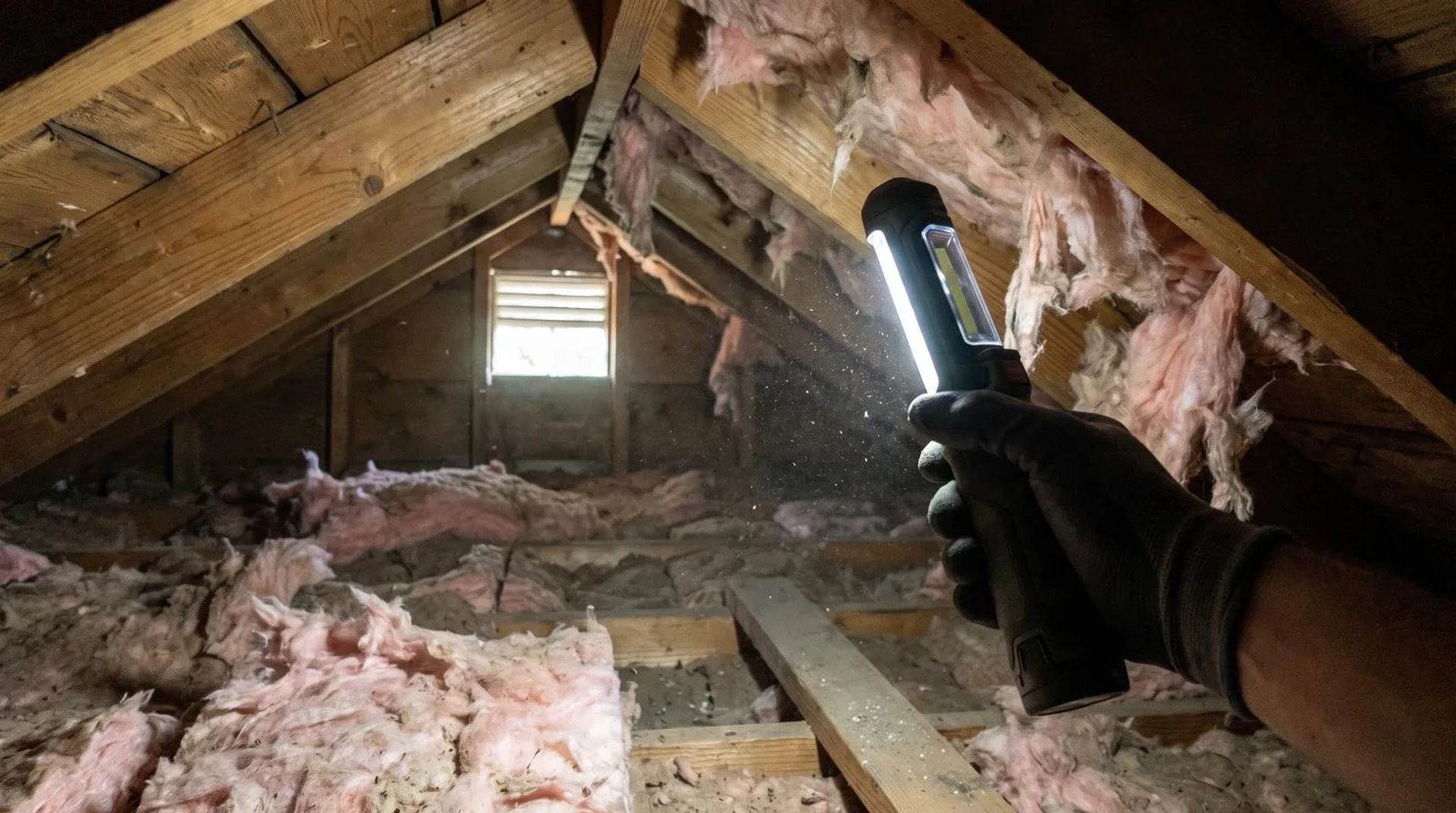
Most of our biohazard cleaning calls in November don't start with anyone seeing a mouse. They start with a smell in the hallway the first cold week, right when the furnace kicks on, and nobody can figure out where it's coming from.
Then someone goes up with a flashlight and finds the blown-in insulation shredded into nests, droppings scattered across the joists like spilled coffee grounds.
That's usually when the phone rings. The question is always some version of the same one: is this a real cleanup job, or can you handle it with a shop vac on a Saturday?
Honest answer, it depends on how long it went on. A few droppings behind the water heater is a paper towel and a spray bottle. Two or three winters of mice living in a Boise attic is a different story.
Why rodent droppings count as biohazard cleaning
Dried droppings and old urine turn to dust. Disturb that dust and it goes airborne. That's the whole problem in one sentence.
Deer mice in Idaho can carry hantavirus. Cases here are rare, and I'm not trying to scare anybody.
But when somebody does get exposed, it's usually the same story. They swept out a shed, an attic, or a crawlspace, and breathed what they kicked up.
Rodent waste can carry salmonella and other bacteria too. Old nesting material is a reliable asthma trigger, so if someone in the house already has trouble breathing, that alone is reason enough to keep them out of the area.
Then there's the smell. Urine soaks into insulation, subfloor and framing, and it doesn't air out on its own. Anyone who's opened an attic hatch on the Bench in August knows what I mean.
Don't sweep it, and please don't vacuum it
Two tools do most of the damage here: a broom and a regular shop vac.
A broom throws the dust straight into your face. A shop vac without real filtration pulls it in and blows it back out the exhaust, spread nice and even through the room. You feel productive the entire time you're making it worse.
If the area is small and you'd rather handle it yourself, the safe version is boring. Gloves, an N95 or better, and you wet the whole area down with a disinfectant before you touch anything.
Let it sit ten minutes. Pick it up damp, bag it, wash up.
What I'd skip is a whole attic, or a crawlspace you have to army-crawl through. Confined space, no airflow, dust everywhere you put a knee. That's the one worth handing off.
Tip: Get the mice out before anyone cleans. If the entry points are still open, you'll pay for the same cleanup twice. Pest control seals it up, traps run a couple of weeks, then the cleaning happens. That order saves real money.
What the work actually looks like up there
We set containment at the access point so nothing drifts down into the living space. Respirators and suits go on before anyone goes up.
Everything gets misted with disinfectant before a single thing moves, because wet material doesn't go airborne.
Then the contaminated insulation comes out and gets bagged right where it sits. Nesting material, chewed cardboard, anything porous that soaked up urine goes with it.
Framing and sheathing get cleaned and treated. We deal with the odor at the material itself, not with a fogger that covers it for a week and then quits.
Timing is fairly predictable. An attic over a small North End bungalow is usually a day.
A crawlspace under a newer place out along Meridian's Ten Mile corridor, with vapor barrier replacement, tends to run two. Older homes in Nampa and Caldwell can take longer, because everything has to move through one small hatch.
Bagged insulation is bulky and light, so dump runs to the Ada County landfill are about volume, not weight. Worth knowing when you're comparing quotes.
What biohazard cleaning costs around the Treasure Valley
I can't give you a real number without seeing it, and anybody quoting an attic sight unseen is guessing.
For shape, though: one bad corner of a garage or a utility closet usually lands in the low hundreds. A full attic on an average Boise or Eagle home, cleaned and stripped, tends to run into four figures.
Crawlspaces with soaked vapor barrier and odor treatment in the framing go higher, sometimes well into the mid four figures on bigger Canyon County properties.
What moves the price is access, square footage, and how much material has to leave the house. A pull-down ladder with six feet of headroom is a different job than an eighteen-inch crawl, even when the square footage matches.
One more thing people ask about. Homeowners policies often treat rodent damage as a maintenance problem and exclude it, so read yours before you count on coverage.
We run into this on estate cleanouts more than anywhere else. A house sits mostly empty for a year or two, nobody goes in the attic, and the mice get comfortable.
The bottom line
Small mess, handle it yourself, and wet it down first. An attic full of nesting and a few years of urine, get someone up there with containment and real respirators, and deal with the mice before the cleaning.
Yes, we'd like the work. But if you're on the fence, call and describe what you're looking at and I'll tell you straight whether it's worth paying for. We're at (208) 330-3615, and looking at it in person doesn't cost you anything.
