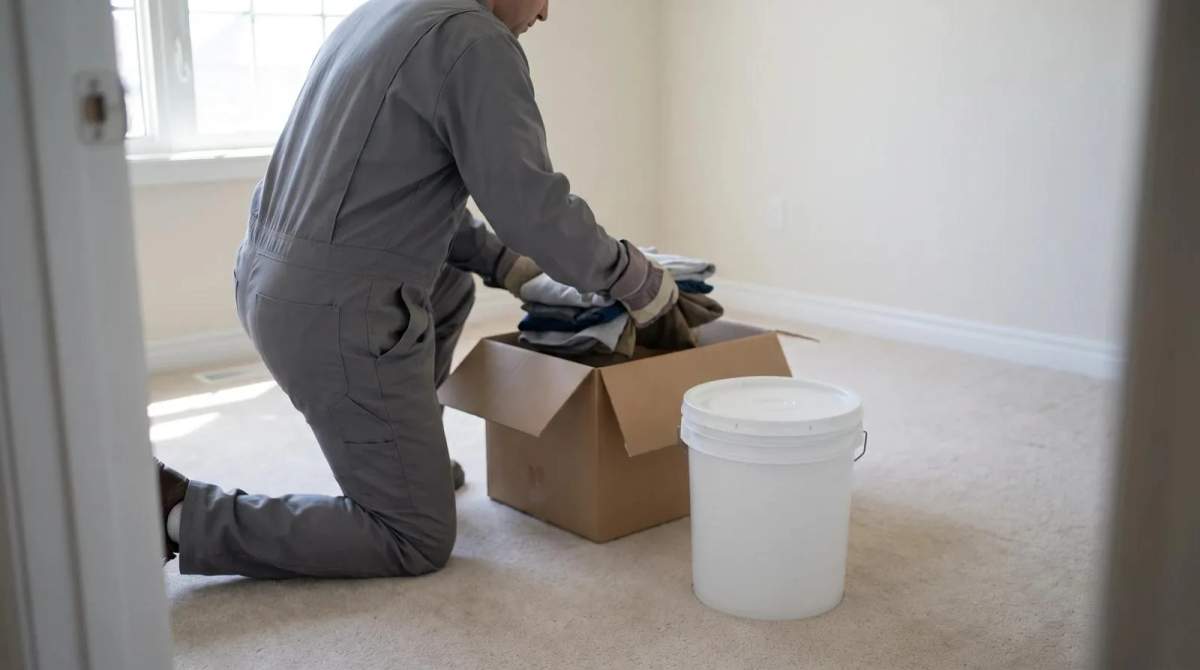
It's almost always a drawer, or a shoebox, or the pocket of a coat that's been hanging in a closet for six years. You reach in for a handful of stuff and something pokes back. For a lot of families, that's the moment a regular cleanout turns into biohazard cleaning.
Finding needles in a home is more common than people expect. Here's what we tell families and landlords around Boise and Meridian when they call us about it, including when it's fine to just handle it yourself.
Don't Jump to Conclusions About Why They're There
Most of the needles we come across in Treasure Valley homes belonged to someone managing a health condition. Usually that's insulin, but we also see blood thinners after a surgery, B12 shots, fertility meds and allergy injections.
Plenty of people used them for years and never had a simple way to get rid of them.
In a hoarding situation, needles tend to stack up the same way mail does. Getting rid of them feels complicated, so they go in a coffee can, and when that fills up they end up in a drawer or a bag under the bed.
Sometimes it is drug use. We don't handle that any differently. The work is the same, and the person who lived there deserves the same respect either way.
What to Do the Moment You Find One
Stop digging with your hands. That's the big one. Where there's one needle there are usually more, and some of them won't have caps.
Don't try to put a cap back on, either. Recapping is how a lot of needlesticks happen, even to nurses who handle sharps every day.
If it's a single needle you can see clearly, put on thick work gloves and pick it up with tongs or pliers. Drop it point-first into a hard plastic bottle with a screw-on lid. An empty laundry detergent jug works fine.
Tape the lid shut and write SHARPS on it in marker so nobody drops it in the recycling. Around Boise, a sealed and labeled container like that generally goes in your regular trash, but a quick call to your garbage company will confirm it.
Then leave the rest of that area alone until you've got a plan.
Heads up: If you do get stuck, wash the spot with soap and water right away and get to your doctor or an urgent care the same day. Don't wait to see if it looks infected. Getting checked quickly after a needlestick really matters, and one short visit beats weeks of wondering.
When a Cleanout Turns Into a Biohazard Cleaning Job
A couple of capped insulin pens in a bathroom cabinet? You can take care of that. Yes, we'd love the work, but honestly, you don't need us for it.
It's a different story when you can't see what you're reaching into. Think piles of clothes, bags of paper, an old mattress, the gap between couch cushions.
In a home with a lot of stuff, a needle could be almost anywhere. The only safe way through is slow, with the right gloves, and without ever reaching in blind.
Finding them in more than one room is a good sign to stop.
So is dried blood on bedding, tissues or the floor nearby. Other problems stacked on top count too, like pests, human waste or a lot of spoiled food.
And sometimes you're just worn out. Maybe you've spent every weekend for a month driving over from Caldwell to work on a parent's house, and you don't want to be the one sorting through this part.
That's a completely fair reason to call. We hear it a lot.
Landlords in Nampa and the rest of Canyon County run into this too, usually after a tenant leaves in a hurry and the unit's still full of belongings.
How We Handle Sharps During Biohazard Cleaning
Our crew wears puncture-resistant gloves, not the thin disposable kind. We don't reach into anything we can't see into. Bags get opened on a flat surface and spread out, and soft things like clothing get handled one piece at a time.
It's slower, and that's on purpose. A bedroom that would normally take a few hours can eat up most of a day when sharps are mixed in.
A full house in the North End or up on the Bench usually runs three to five days, and needles push it toward the long end. In July, in a closed-up house with no AC, that also means a lot of water breaks.
Sharps go into proper containers as we find them. They're kept out of the regular load, and we'll tell you where they can be dropped off. Anywhere we found blood gets cleaned and disinfected, not just wiped down.
So what does it cost? It depends on how spread out things are.
A drawer of needles in an otherwise tidy house barely moves the price. Sharps scattered through a full home add real time and care, and that shows up in the estimate.
Either way, we'll walk through the place with you and give you a straight number before anyone starts.
The Bottom Line
If you find a needle, stop, don't recap it, and don't keep digging. One or two out in the open are something you can safely take care of yourself.
A house where you can't see what's under the next layer is a different job.
Not sure which one you're dealing with? Give us a call at (208) 330-3615. We'll talk it through, and if it's something you can handle on your own, we'll tell you that too.
