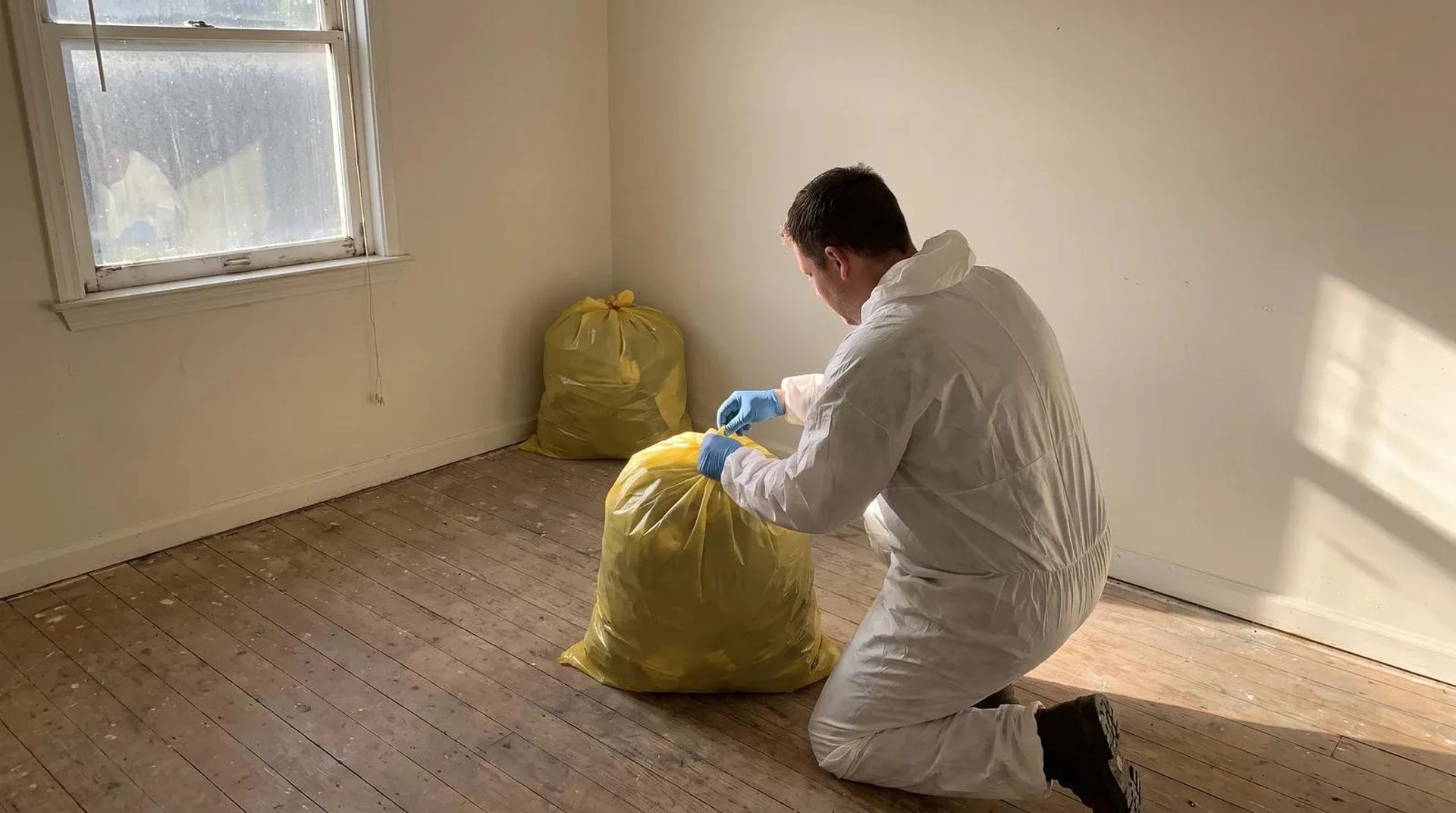
A woman in Nampa called us last spring holding a sticky note. Claim number, adjuster's name, a phone number she'd already tried twice. Her first question wasn't about the biohazard cleaning at all.
She wanted to know if she was about to pay for the whole thing herself.
That's what almost everyone wants to know first, and it's the part nobody answers straight. So here's the honest version, from people who've stood in these houses waiting on an adjuster to call back.
What homeowners insurance usually covers for biohazard cleaning
Most standard Idaho homeowners policies cover this work when it comes from something sudden and accidental. Sewage pushing up through a basement floor drain. A death in the home. An injury bad enough that it reaches more than one room.
Those claims usually go through. The insurer isn't paying because the situation is awful. They're paying because something happened on a specific date, and the policy names it.
Coverage often runs past the cleaning itself. Pulling contaminated carpet and pad, cutting out affected drywall and subfloor, hauling the material away, and sometimes rebuilding the room afterward.
Personal property that can't be saved may be covered too, under a separate part of the policy with its own limit.
Renters have their own version. A renters policy tends to cover your belongings and sometimes the cleanup, while the building falls under the landlord's policy. If you own a rental in Meridian off the Ten Mile corridor, your dwelling policy is the one to call, and tenant-caused damage is where the arguing starts.
Why these claims get denied more often than people expect
One word decides most of them: gradual.
Insurers pay for events. They don't pay for conditions that built up slowly. Animal waste that accumulated over years, moisture nobody addressed, a house that got away from someone during a rough stretch of life.
Adjusters read all of that as wear and tear, and the policy language usually backs them up.
That's a hard letter to open. Hoarding is a mental health condition, and it doesn't fit a claim form that only has boxes for hail and burst pipes. We've watched families get that letter and feel judged twice over.
Sewage is its own trap. Water backing up from a city line or a septic system is often excluded unless you carry a water backup endorsement, which is a small add-on most people never think to buy.
Got an older place on the Bench or in Boise's North End with original drain lines? Pull your declarations page out this week instead of after.
Heads up: Photograph everything before a single item moves. Wide shots of each room, then close-ups of the affected areas, plus the ceiling and the floor. Adjusters approve what they can see, and once the material is bagged and gone, there's no recreating it.
Getting biohazard cleaning started before the adjuster calls back
Here's the tension nobody warns you about. Most policies require you to prevent further damage, and these situations get worse fast.
A Treasure Valley summer with the house shut up and nothing running will move things along in a hurry. Winter isn't much kinder once the furnace kicks on and starts pushing air through contaminated ductwork.
So waiting three weeks on an approval isn't a neutral choice. It usually raises the final number.
What we do is document heavily, stabilize the immediate hazard, and hand you a written scope with itemized lines an adjuster can actually work from. Most carriers want it broken out by room and task, not one lump sum.
We'll talk to your adjuster directly if you want. That isn't a favor we're doing you. It just moves the file.
Timing helps set expectations too. One contaminated room is often a single day. A whole home with subfloor removal and repeated dump runs out to the Ada County landfill lands closer to three to five days, longer if there's structure to replace.
What it costs when there's no coverage
Plenty of these jobs get paid out of pocket, especially with Canyon County rentals and estate situations where a policy lapsed years ago.
A contained single-room cleanup with limited demolition tends to land in the high hundreds to low thousands. Multiple rooms with subfloor cutting, heavy protective gear, air scrubbing, and regulated waste disposal moves into the several-thousand range.
A whole house is its own conversation, and it depends almost entirely on how far the contamination traveled.
Square footage isn't what drives the price. It's how much material has to leave and how it has to be handled. Regulated waste can't ride to the transfer station with the old couch.
If money is the wall you're up against, say so on the first call. Phasing the work room by room is normal, and we'd rather scope it honestly than watch somebody put it off another year.
The bottom line
Sudden events usually get covered. Slow ones usually don't. Photograph everything before you touch it, find out whether you carry a water backup endorsement, and don't let a pending claim stall work that's actively getting worse.
If you're in Boise, Meridian, Nampa, Caldwell, or Eagle and you can't tell which side of that line you're on, give us a call at (208) 330-3615. We'll walk through it with you, and if we think you've got a real claim, we'll help you put the paperwork together. No pressure either way.
