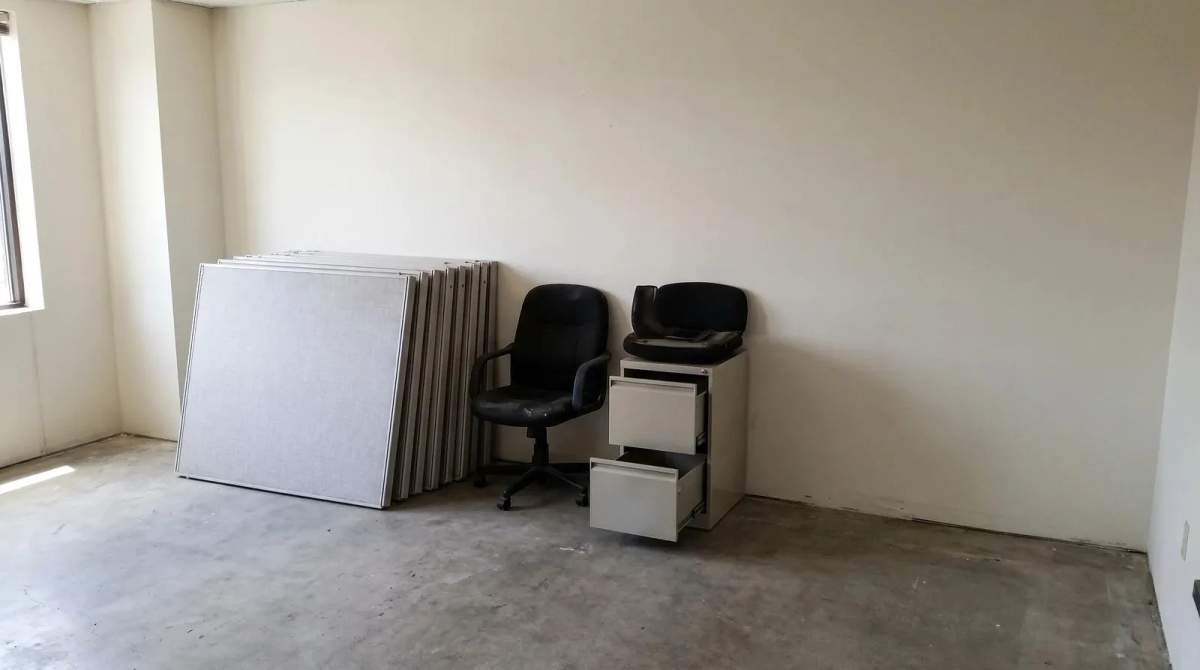
Desks, chairs, and a stack of cubicle panels leaning against a wall where somebody already gave up on them. Most of a Boise commercial cleanout goes about how you'd expect, but the office furniture is the part that catches people.
Trying to give it away for free often goes nowhere.
That's just how used office furniture goes right now.
Why nobody wants your used desks
The secondhand office furniture market in the Treasure Valley is thin, and it got thinner once half the valley learned to work from a spare bedroom.
Cubicle systems are the worst of it. They're proprietary, they need the right connectors and trim, and a panel from one brand won't lock into another. Once a system comes apart, it's mostly just heavy panels with fabric on them.
Laminate desks don't hold up either. Particleboard swells the second it meets water, so a desk that sat under a slow roof leak is done. Same story with task chairs once the gas cylinder gives out.
Some things still move, though. Real wood furniture sells. So do metal filing cabinets, decent conference tables, and anything under about five years old that's still part of a current product line.
Lateral files especially. Somebody always needs lateral files.
So before you plan anything, separate the pieces with a second life from the pieces that are just weight. Those are two different problems, and they don't cost the same to solve.
What a Boise commercial cleanout actually costs
We price on volume, weight, and how hard the building makes it on us.
A small suite, say a thousand or twelve hundred square feet with normal office contents, usually lands somewhere in the high hundreds to low thousands. A full floor, or a call center with sixty workstations, climbs from there fast.
The things that move the number aren't the ones people expect.
Stairs matter more than square footage. A second-floor suite in an older building on the Bench with no elevator can add half a day to the same pile of furniture we'd clear from a ground-level space in Nampa before lunch.
Disassembly matters too. Cubicles have to come apart before they go anywhere, and that's slow work with a hex driver. You don't speed it up by adding people.
Weight matters because the Ada County landfill charges by the ton. Particleboard is dense, and a room of it weighs a lot more than it looks like it should. Twenty desks can outweigh a whole house's worth of household goods.
Tip: Walk the space and count before you call anyone for a quote. Desks, chairs, filing cabinets, monitors, cubicle stations, whether there's an elevator, and how far the nearest door sits from a spot we can load from. That's most of what we need to give you a real number on the phone instead of a guess.
Donation helps, but it has limits
We'd rather keep usable stuff out of the landfill, and a fair amount of it does find a home. Churches, small nonprofits, a startup working out of a garage in Eagle, a school that needs tables. Some of it goes to families setting up a first apartment.
But donation doesn't solve volume. A nonprofit will happily take four good chairs. They won't take forty, because they don't have anywhere to put them either.
And nobody accepts furniture with water damage, mold, or a broken frame. That's fair.
Electronics are their own thing. Monitors, old towers, printers and copiers get handled separately from general debris, and copiers are heavy and full of toner. Don't stack those on a trailer with everything else.
One more thing worth saying plainly. Check every drawer before anything leaves the building. We find client files, tax records and personal paperwork in desks constantly, and that's yours to deal with, not something to find out about later.
Timing your commercial cleanout around the lease
Most of these jobs run on a date somebody else picked, and that date is rarely generous.
A single suite is usually one day. A bigger office, or a space with a warehouse attached, runs two to three. If there's flooring to pull or walls to patch behind us, build in time for it, and don't put the carpet crew in the same afternoon we're walking panels down a stairwell.
Should you book the cleanout before or after you hand back the keys? Before. Almost always before, because a landlord who's already taken possession has no reason to keep the door unlocked for you.
Season plays in more than you'd think. If you've given notice, the HVAC may already be off, and a west-facing suite in August with no air moving gets rough by two in the afternoon. Winter flips it: icy loading areas, short daylight, and dock doors propped open all day.
Book two weeks out if you can. End of month and end of quarter are the busiest stretches in Boise, Meridian, Nampa and Caldwell alike, because every lease in the valley seems to end on the same Friday.
The bottom line
The furniture is the expensive part, not the trash. Figure out what's actually reusable, get the drawers emptied, and count what's left so you're not guessing on the phone.
Then get on a schedule before your last week, not during it.
If you want a straight number for your space, give us a call at (208) 330-3615. We're happy to walk it with you, or just talk it through if you already know what's in there.
