Hoarding Cleanup in Boise: Why the Fridge Is a Biohazard Job
Most people walking into a hoarded home for the first time figure the piles will be the hard part. Then somebody reaches for the refrigerator door.
If you're planning a hoarding cleanup in Boise, the fridge needs its own plan. It's often the most dangerous spot in the house, even when the kitchen around it looks manageable. Here's why, and what to do (and not do) before anyone opens it.
Why the fridge turns into a biohazard in hoarded homes
A refrigerator only works if somebody keeps it working. In a hoarded home, that tends to stop at some point.
Stuff gets stacked against the door and the seal doesn't close right. The coils on the back get buried, and the compressor runs hot until it quits. Sometimes the breaker for that outlet trips and nobody notices, because the kitchen isn't really being used anymore.
The food inside keeps breaking down either way. Meat and dairy turn to liquid. Mold spreads over everything.
That liquid finds the lowest point. First the crisper drawers, then the drip pan, and eventually the floor under the fridge.
So biohazard cleanup in hoarded homes very often starts in the kitchen. A sealed box of rotting food is full of bacteria, and once the door opens, it's in the air you're breathing.
What not to do before the crew shows up
The instinct is to open it, see how bad it is, and start bagging. Please don't.
Don't open the door to check. The smell alone can knock you back, and whatever's built up in a long-sealed fridge isn't something you want in your lungs. A closed door already tells you what you need to know.
Don't empty it into kitchen trash bags. Thin bags tear under wet weight. A leaking bag dragged across a cluttered floor just spreads the mess through the house.
Don't tip it or drag it out yourself. Fridges hold liquid in places you can't see, and tilting one sends it out the bottom. Moving a heavy appliance down a narrow, cluttered path is also how people get hurt.
And skip hosing it out in the driveway. That runoff heads for the storm drain, and that's not where it belongs in Boise, Meridian, Nampa or anywhere else in the valley.
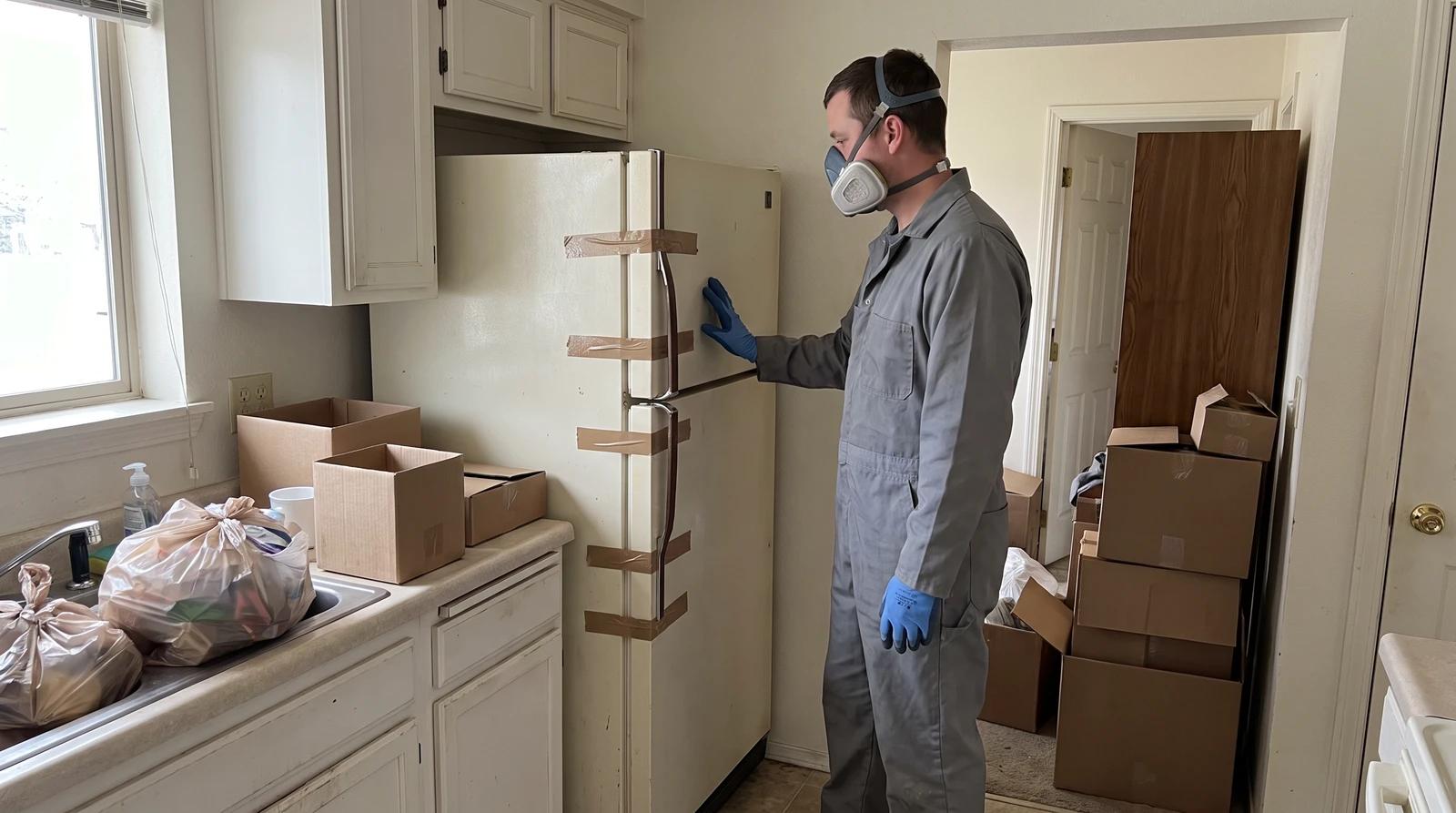
Tip: If the fridge is still running and cold, leave it plugged in. If it's off, don't plug it back in to "help," since warming and cooling it again just stirs things up. Either way, a strip of duct tape across the door keeps curious relatives and pets out until it's dealt with.
How a hoarding cleanup in Boise handles the fridge
There's nothing mysterious about it. It's slow, careful work.
Protective gear goes on first: gloves, eye protection, respirators and disposable coveralls. Then the path from the kitchen to the door gets cleared, so nothing has to be carried over piles.
The contents go into heavy-duty sealed containers instead of loose bags. Liquids get absorbed and contained, not poured. Shelves and drawers come out on their own.
After that it's a judgment call. Some fridges can be cleaned, disinfected and kept. Plenty can't, because once rot gets into the insulation and door gaskets, the smell tends to come back no matter how hard you scrub.
The floor underneath matters too. If liquid soaked into the subfloor, that spot gets cleaned and treated along with the appliance. It's easy to miss, and it's a common reason a kitchen still smells after the fridge is gone.
Then there's getting rid of it. You can't just set a fridge at the curb. Refrigerators and freezers hold refrigerant, and federal rules require it to be recovered properly before the appliance is scrapped.
Drop-off rules also depend on where you live. Ada County's landfill and Canyon County's facilities each handle appliances their own way, so check current requirements before loading anything up. Someone in Caldwell may be dealing with a different site than someone in Eagle or Garden City.
Once metal appliances are emptied and cleaned, they can often be recycled instead of buried.
Don't forget the garage freezer
This is the one people miss. A lot of Treasure Valley homes have a chest freezer or an old fridge out in the garage or the shop.
Garages get brutally hot in a Boise summer. If that freezer lost power, whatever's inside has been cooking for a while.
Winter can fool you. Freezing temperatures slow things down, so it might look fine in January. It won't stay that way once spring warms it up.
Treat it exactly like the kitchen fridge. Tape it shut, leave it alone, and bring it up when you set up the estimate so it's part of the plan from the start.
What a bad fridge does to the cost
Is a biohazard fridge going to change the price? Usually, yes, because it adds work.
We price hoarding cleanup by the space and the work involved. How long the fridge has been sealed, whether it's leaked, whether the floor took damage and how hard it is to get out of the house all play into it.
That's why we look in person. The free on-site estimate gives you a firm price before anything is touched, with no hidden fees. We take cash, card and Venmo, and same-day service is possible when the schedule allows.
Yes, we'd like the job. But honestly, the most useful thing here is simple: if there's a fridge in the house you're nervous about opening, trust that feeling. Keep it closed, tape the door, and let people with the right gear handle what's inside.
If you want someone to come take a look, call us at (208) 330-3615. No pressure, just a straight answer about what's there and what it'll take.
More From Our Blog
Hoarder House Cleanup in Boise During Probate: Who Signs Off
Cleaning out a hoarded home while the estate is in probate? Here's who can approve the work, what to save first, and how to plan hoarding cleanup in Boise.
Landlord Hoarding Cleanup in Boise: Commercial Rental Units
A commercial unit packed to the ceiling? How landlord hoarding cleanup in Boise works: the lease, business records, hazards, and getting it leased again.
One-Room Hoarding Cleanup in Boise: When It's the Garage
A hoarded garage is its own kind of one-room hoarding cleanup in Boise. What's usually buried out there, how the work goes, and when to call for help.
