A woman called us last July from her car, parked in her dad's driveway off State Street. She'd been sitting there close to forty minutes. The coroner had already come and gone, the front door was standing open, and she wanted to know one thing: what she was supposed to do until a biohazard cleaning crew could get there.
That's the part nobody plans for. Most of what people actually need to know happens in the hours before a crew ever pulls up, and there's no pamphlet for it. You're making decisions while you're still in shock.
So here's what we tell people in Boise, Meridian, Nampa and the rest of the Treasure Valley when they call and the house is still exactly the way it was.
Should you go inside?
Most of the time, no. Not yet.
It isn't about the room being upsetting, though it might be. Blood and other bodily fluids can carry hepatitis B, hepatitis C and MRSA, and none of that announces itself. A surface can look completely dry and still be a live problem.
Your eyes aren't a good test.
There's a second reason people don't think about. Walking into a room and back out tracks contamination down the hall, onto the stair treads, into carpet that was fine ten seconds earlier. We've watched a one-room job turn into a three-room job because five family members made that same trip over a weekend, each of them just trying to see for themselves.
If you need something specific out of there, call before you go get it. Medication, a wallet, the cat, the folder with the will in it.
Sometimes there's a clean path and we'll walk you through it on the phone. Sometimes there isn't, and we'll pull it out for you once we're on site.
What to leave alone until the biohazard cleaning starts
Don't move furniture. Don't start pulling carpet. Don't bag up the bedding to run it to the laundromat, even though that's the instinct almost everyone has.
Two reasons. If there's any chance of an insurance claim, the adjuster wants to see the room roughly as it was, and photos taken before anything moves are worth a lot more than photos taken after.
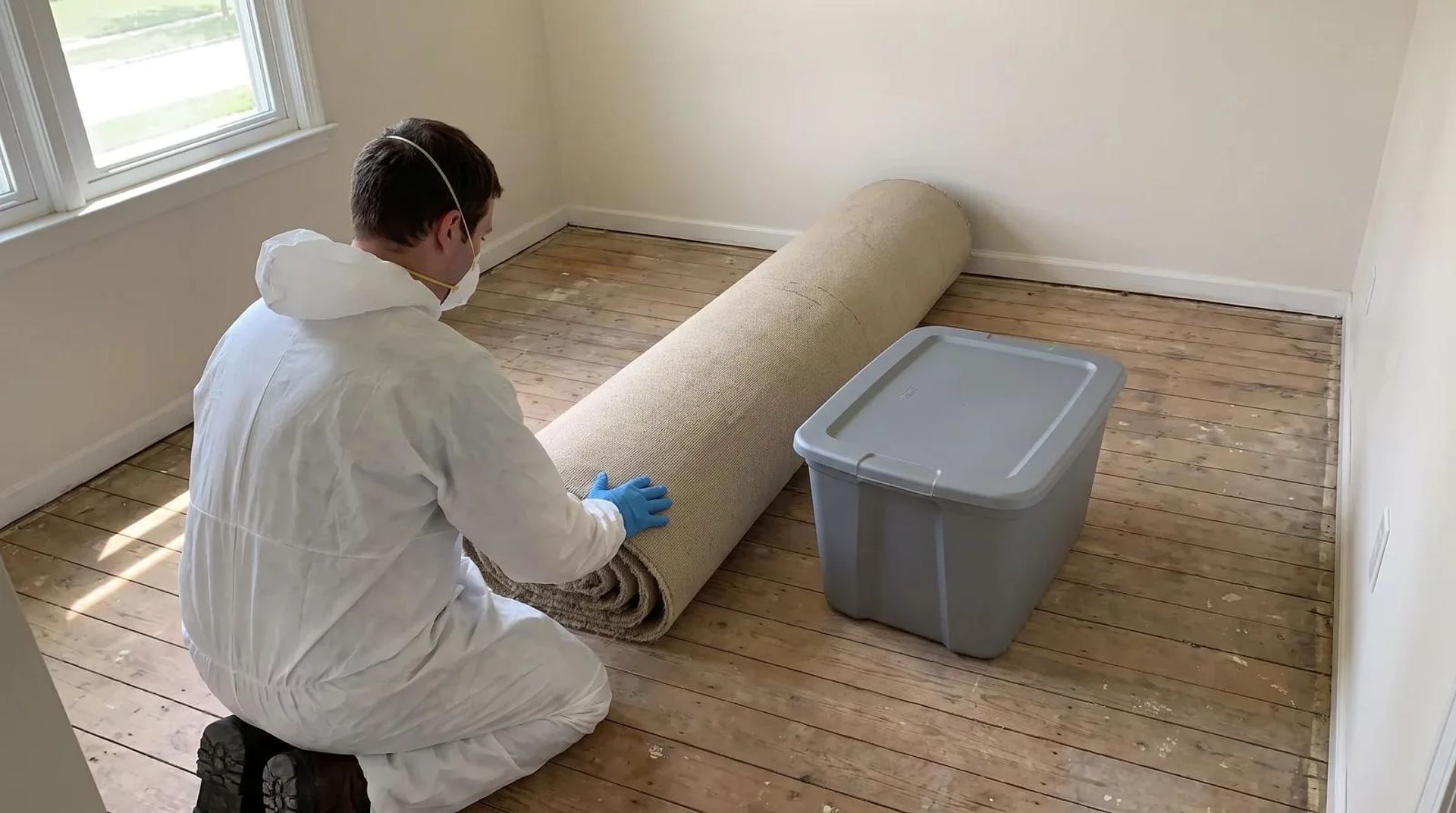
The other reason is simpler. Household cleaners tend to spread this kind of contamination around instead of removing it. Porous material soaks it in and holds onto it: carpet pad, drywall, particleboard, an old subfloor.
Scrubbing the surface just moves the problem somewhere you can't see it.
Heads up: Turn the furnace and the AC off before you leave, and don't turn them back on. Running the blower pulls air out of the affected room and pushes it through every duct in the house, which is how a single-room job becomes a whole-house odor job. It's the one thing you can do in thirty seconds that saves real money.
The small stuff that genuinely helps
Summer here works against you. A closed-up house on the Bench during a 100-degree stretch does more damage in two days than the same situation does in two weeks in February.
If you can safely crack a window in a part of the house that isn't affected, that helps a little. If you can't reach one without walking through the room, skip it. Not worth it.
Winter has its own wrinkle. Cold slows the odor down, which buys you time, but if the heat's off in a vacant house in Caldwell in January, you've traded a biohazard problem for a frozen pipe problem. Leave the heat on low and tell us when you call so we can plan around it.
After that, three quiet things. Find the homeowner's or renter's policy. Write down the timeline while it's still fresh in your head. Pick one person in the family to be the contact, because everybody does better when four people aren't calling us with four slightly different versions of the story.
What biohazard cleaning costs and how fast we can get there
We can usually be out same day or the next morning anywhere in Ada or Canyon County. Boise's North End, the Ten Mile corridor in Meridian, Eagle, Nampa, Caldwell. Call the moment you know you need somebody, even if you haven't decided anything yet.
A contained single room is often one day. When fluids have reached the subfloor, or more than one room is involved, or there's an odor stage to work through, you're looking at three to five days plus a return trip to confirm the smell is actually gone and not just covered up.
Cost is honest guesswork until somebody sees it. A small contained room usually lands in the high hundreds to low thousands. Once flooring is coming out and there's structural odor work, it climbs into the several thousands.
Anyone who gives you a firm number over the phone is guessing too. They're just not telling you.
One detail that surprises people: what we haul out doesn't go to the Ada County landfill with the rest of the household junk. Regulated waste leaves in sealed containers through a licensed handler, with a paper trail. Belongings that aren't contaminated get handled separately, and we'll ask you before anything sentimental goes anywhere.
Bottom line
Shut the HVAC off, stay out of the room, don't clean anything, and call somebody. Everything else can wait until a person who does this for a living is standing in the house with you.
Yes, we'd like the work. But even if you hire someone else, make the call early.
If you're anywhere in the Treasure Valley and you're sitting in a driveway right now trying to figure out the next step, we're at (208) 330-3615. Ask whatever you need to ask.
